Dmitri
The Reincarnated Demon King's Host Just Wants to Live in Peace, But the Hero Won't Leave Him AloneDmitri is a half-elf farmer’s son from Leafel whose relationship with Micah forms one of the book’s clearest small-scale stories of maturation. Introduced as a freckled, straw-haired twelve-year-old who helps his father Raf, he first appears through misdirected aggression: he follows Micah, grabs their wrist, and frightens them while claiming that he wants to protect them. Theo’s intervention exposes the feeling beneath the bullying. Dmitri has a crush on Micah, but the connection only becomes meaningful when he accepts that protection cannot mean control and agrees to become Micah’s friend instead.
Identity and Introduction
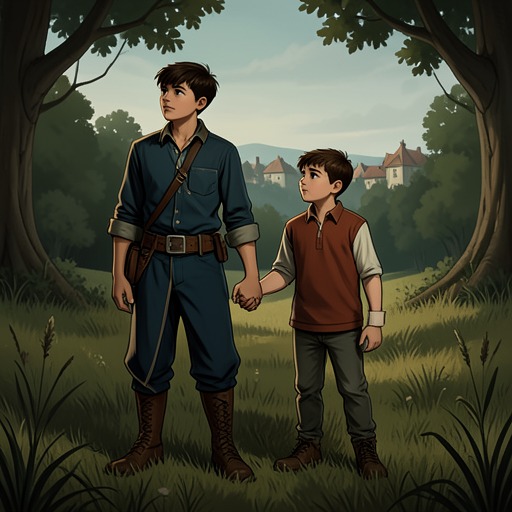
Dmitri is described as scrawny, freckled, and slightly pointed-eared, with coloring inherited partly through his mother’s elven ancestry. His father is Farmer Raf, and Dmitri assists him with the goat-drawn cart and farm work. He is also known among the village children as a menace, and Theo initially dislikes him both for that behavior and because he has caught Dmitri picking on Micah. This first impression places Dmitri on the wrong side of a moral line, but it does not make him an irredeemable aggressor; his conduct is presented as an immature attempt to act on concern and attraction without understanding either.
The decisive confrontation occurs in an alley while Micah is carrying a basket of produce, likely sent on an errand because Glefald is bedridden. Dmitri has Micah pressed against a wall and is demanding an explanation while Micah cries and says that Dmitri is hurting them. When Theo challenges him, Dmitri says that he wanted to protect Micah and had followed them because he did not want anyone else to hurt them again. His embarrassed admission that he thinks Micah is pretty clarifies the emotional source of the pursuit, while Micah’s response establishes the boundary Dmitri must learn to respect.
Friendship and Daily Responsibility
Micah refuses the role of dependent victim. They identify themself as a mage, remind Dmitri that they are the youngest person ever to join an adventurer party, and say that they do not need his protection. They nevertheless offer friendship, and Dmitri immediately accepts. The offered hand transforms the scene from coercion into mutual recognition: Dmitri is not rewarded for frightening Micah, but he is given a legitimate way to remain close. Theo reinforces the lesson by warning him that any further misconduct will have consequences, regardless of Dmitri’s age.
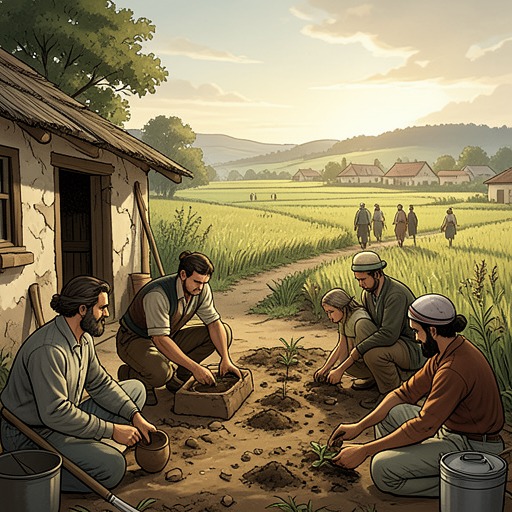
Dmitri’s new friendship soon becomes part of ordinary village life. When Mal has been absent from Theo for three days and Theo feels increasingly lonely, Micah becomes his most constant companion, with Dmitri as Micah’s faithful shadow. The two young people help Theo in the garden, where Dmitri proudly demonstrates the agricultural skills learned from his father. They also begin helping in the shop, giving Dmitri a practical role in the household rather than leaving him merely as Micah’s admirer.
When Theo is forced to leave, he entrusts Dmitri with concrete duties. Micah is placed in charge of the shop, but Dmitri is ordered to care for the garden and flock, with the harvest and eggs to be delivered either to Imani and Dale or to the Watchtower. The assignment shows that Theo sees Dmitri as capable of responsibility, even while he remains bluntly concerned about the danger of mistakes. Micah’s hug and request that Theo return soon place Dmitri within the same emotional circle: he is no longer an outside nuisance but part of the young household Theo has taught and protected.
Relationship with Micah and Growth
Dmitri’s devotion to Micah remains visible as the seasons pass. Mal spends time with both young people despite his stated distaste for children, and Micah and Dmitri become somewhat obsessed with him. Dmitri continues to be adorably devoted to Micah, his brown eyes lighting up whenever the cat mage appears. The affection that once produced stalking and bullying has not disappeared; it has been redirected into companionship, patience, and an aspiration to share Micah’s future.
Micah also changes in ways that alter the balance between them. They become more confident in both themself and their magic, developing a new steadiness that makes them seem older than their ten years. Their training combines Theo’s healing instruction with Wicker’s necromancy, an unusual but effective union of life and death. Dmitri’s role is not to make Micah smaller or safer by keeping them close; instead, he begins imagining how he can grow enough to remain beside them when their life expands beyond Leafel.
The book leaves open the question of whether Micah and Dmitri will continue together when Micah begins adventuring after reaching the proper age. Dmitri’s developing combat training suggests that he is already preparing for that possibility. Luc teaches him when he can draw Luc away from renovations, while Dmitri also seeks instruction from Theo, wanting a path that will allow him and Micah to stay together in the wider world. Their relationship therefore moves from childish infatuation toward a shared, though still unconfirmed, future.
Ambition and Emerging Adulthood
By the time Dmitri is thirteen, his physical and emotional development is becoming visible. His body is lengthening and toning through farm labor, his face is sharpening, and his once-straw-colored hair is turning more golden. These details make his growth tangible rather than merely declarative. He is still devoted to Micah, but he is no longer presented solely as a boy whose feelings overwhelm his judgment; he is becoming a young worker, student, and prospective adventurer.
His request to Theo makes that ambition explicit. While helping clear the garden before the frost, Dmitri asks whether Theo will teach him how to fight. He acknowledges that Luc’s instruction has been valuable but believes Theo may be a better teacher because Theo was trained by an elf. Dmitri’s request is tied to labor and reciprocity: he has helped maintain the garden, and he asks for instruction not as an entitlement but as the form of repayment he wants.
Dmitri then states his purpose plainly: he wants to become an adventurer so that he and Micah can remain together and so that he can protect them. The declaration echoes his first appearance, but its meaning has changed. Earlier, “protection” justified following Micah and hurting them; now it is connected to discipline, training, and a chosen vocation. Theo still warns him to keep his hands to himself and reminds him that there will be time for romance when he is older, but Dmitri’s earnestness shows that his feelings have become part of a larger plan for adulthood.
Narrative Role and Significance
Dmitri’s arc is a compact example of the book’s preference for chosen bonds over imposed roles. He is not a grand political figure, a demon lord, or a member of the Hero’s party, yet his development parallels the larger story’s concern with how people learn to choose their own forms of loyalty. His first instinct is possessive and clumsy; his later conduct is cooperative, useful, and future-oriented. Friendship becomes the ethical form through which attraction can survive without becoming coercion.
His connection with Micah also extends the circle of family Theo builds in Leafel. Theo’s own history includes fear, forced duty, and the struggle to preserve a quiet life, while Dmitri and Micah represent a younger generation learning skills, affection, and independence within the safety of that community. Dmitri works the land, tends the flock, labels potion bottles, studies combat, and imagines a life of adventure. Those ordinary acts give the future a material foundation: the possibility of staying together is expressed not through a promise of destiny, but through shared labor and preparation.
By the ending material, Dmitri has not yet become an adventurer, and the book does not confirm the final shape of his relationship with Micah. It does establish the direction of his transformation. The boy who once hurt Micah while claiming to defend them learns to accept their boundaries, offers friendship, takes responsibility for Theo’s home, trains under experienced figures, and chooses a vocation that may let him accompany Micah rather than restrain them. His unfinished future is therefore hopeful precisely because it has been earned through change.